
Wah, kakis, sit down, order one cup of Kopi C Peng, and let me spill the latest F&B tea for you. You know Bai Nian Niang Tou Fu right? That super famous stall where people willingly queue until legs weak just to get a hot bowl of fish paste and prawn balls?
Well, turns out running a single, popular hawker stall is completely different from running an entire 500-seat food court. Their 29-year-old second-generation boss, Tommy Pang, recently dropped a video on Instagram coming clean about a massive financial disaster: the family-run Bai Nian Food Court at ESR BizPark @ Chai Chee bled a heart-pain $250,000 in just 7 short months. Sweat already!
Grab your kaya toast, because here is the full, unfiltered, step-by-step breakdown of how this F&B nightmare went down.
1. The Building is “Dead” 👻
When asked about why the food court was losing money like a leaking pipe, Tommy didn’t give any corporate PR fluff or PR-trained canned answers. He went straight no filter: “The building is dead.”
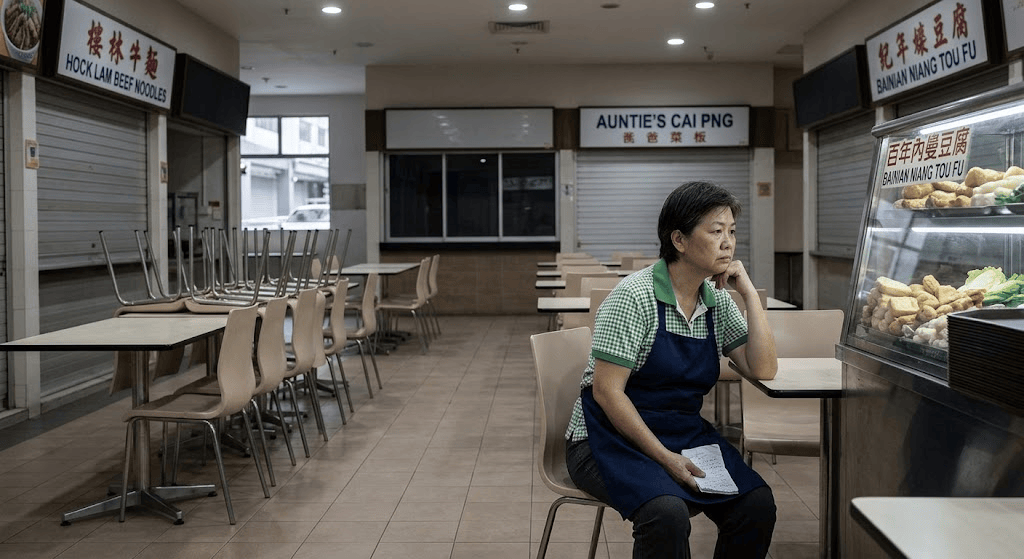
The Pang family has actually held the master lease for this massive 400-to-500-seat food court space since 2017—it is the only full-sized food court they operate. Back in the day, business was doable. But then COVID-19 hit, companies moved out, work-from-home became the default setting, and foot traffic collapsed. Post-pandemic, while the rest of Singapore rebounded, ESR BizPark @ Chai Chee remained completely frozen in time.
On typical weekdays, the entire food court operates at an abysmal 10% to 20% capacity. Tommy recounted showing up during peak lunch hour on a weekday, expecting to see office workers jostling for seats, only to count four or five tables occupied in the entire massive hall. We are talking about a space so eerie and silent that if you drop a single chopstick on the floor, you can hear the echo bounce off all four walls!
2. Weekend Lifesavers vs. Weekday Ghost Town 🎨
Now, you might be thinking: if it’s an industrial/business park, weekend must be completely 0% capacity, right? Surprisingly, no!
Tommy revealed that weekends are actually not bad—the food court hits around 80% capacity during weekend lunch. Why? Because ESR BizPark @ Chai Chee happens to house several children’s enrichment centres and tuition hubs!
On Saturdays and Sundays, parents drop their kids off for class and head to the food court to drink coffee and eat noodles while waiting. But here’s the math problem: two afternoon lunch rushes on the weekend simply cannot compensate for five full days of total radio silence from Monday to Friday. You cannot keep a 500-seat air-conditioned hall alive on “tuition parents” alone!
3. The Great Tenant Escape & “Ownself Do, Ownself Suffer” 🍜
Normally, the business model for a food court operator is simple and low-risk: master-tenant leases the whole place, sublets individual stalls to independent hawkers for monthly rent, sits back, collects passive income, and cleans the tables. Tommy even clarified that they weren’t trying to squeeze people—they were charging modest rents, just enough to cover the master lease fee they owe to the building landlord.
But independent hawkers are not blind. They would walk into the building on a Tuesday at 1:00 PM, see three people walking around, shake their heads, and siam fast-fast. Nobody wanted to sign a lease! To make matters worse, a Western food vendor who had actually signed on recently abruptly packed up, terminated their contract, and forfeited their entire security deposit just to run away from the location.
Left with an empty hall and a landlord expecting monthly rent, the Pang family was backed into a corner. To prevent the place from looking like a desolate, abandoned warehouse, they took matters into their own hands and ended up operating 7 out of the 8 stalls themselves!
They crammed the hall with their own internal F&B portfolio and spin-off brands:
- Bai Nian Niang Tou Fu
- Shi Nian Pork Leg Rice
- Hae! Mee (Prawn Noodles)
- …plus additional self-run stalls for Chicken Rice, Economic Rice (Cai Png), and Fish Soup!
Imagine the administrative nightmare! Not only were they paying rent on a massive master lease, but they also had to hire cooks, hire stall assistants, order raw ingredients, manage supply chains, and execute seven totally different culinary menus—all inside a building with no customers. Bo lang (no people) means bo money, so running seven stalls in a ghost town just meant burning cash seven times faster!
4. High Overheads = $35,000 Burned Every Month 💸
In Singapore F&B, fixed expenses wait for nobody:
- The landlord doesn’t care if nobody bought chicken rice; rent is due on the 1st.
- SP Services doesn’t care if the hall is empty; the central air-con and commercial lights still draw power 12 hours a day.
- Staff still need their monthly basic salaries whether they cook 100 bowls or 2 bowls a day.
When you add up master lease rent, utility bills, raw ingredient waste, and staff wages across seven stalls, their bank account bled out fast. Losing $250,000 in 7 months works out to burning roughly $35,000 to $36,000 every single month. That is equivalent to taking a brand-new, entry-level Japanese sedan and driving it straight into the Singapore River every 30 days!
5. Tommy Pang’s F&B Rollercoaster Drama 🎭
If 29-year-old Tommy Pang’s name sounds familiar to you, it’s because this is actually not his first time publicly detailing painful business losses. In fact, he is rapidly becoming Singapore F&B’s most refreshingly honest (and unfortunate) serial storyteller:
- The $500k Pork Leg Rice Loss: Just a year ago, Tommy went viral after posting a video admitting that his family’s pig trotter rice brand, Shi Nian, lost $500,000 in six months. Why? They expanded way too fast during the hawker-hype era, ballooning to over 30 outlets nationwide before realizing the central kitchen and quality control couldn’t keep up with the soaring rent and labor costs.
- The Eunos Eviction Incident: Just recently, his popular Cantonese/Hong Kong-style eatery Dudu located in a Eunos industrial canteen was forced to shut down permanently. After sinking over $90,000 into renovations and equipment, the landlord suddenly hit the master tenant with a last-minute one-month notice non-renewal, leaving Tommy’s business stranded with nowhere to go.
The Moral of the Story 💡
In real estate and F&B, the golden rule remains 100% undefeated: Location, location, location!
You can have the most legendary Yong Tau Foo recipe in Singapore, a famous brand name, and decades of family experience, but if you put your shop inside a dead business park during a work-from-home era, your bank balance will still gg faster than you can finish a cup of Kopi O Kosong.
Moral for us regular Singaporeans? Next time you pass by a quiet hawker or small local food court that you actually like, buy a bowl of noodles to support them. Otherwise, tomorrow you go back, the shutter closed forever already!
Enjoyed this post? Here’s the absolute best of what we’ve ever published.
☕ Kopi Kaki Classics: Our Top 10 All-Time Hits 🏆
Out of all the posts we ever wrote, these 10 are the absolute champions. The whole kopitiam read already—now your turn.







 Kopi Kaki SG
Leave a comment