
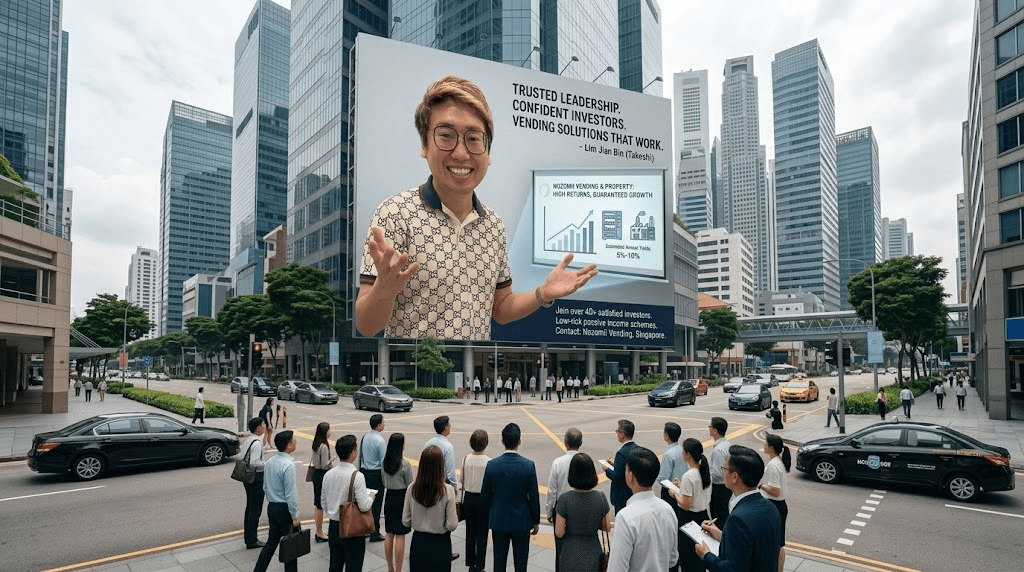
The allure of passive income paired with a rags-to-riches story is a powerful pitch. In Singapore’s fast-paced investment landscape, few narratives sell as effectively as the self-made entrepreneur who beat the odds. However, as the sudden bankruptcy of Nozomii Vending’s founder shows, flashy luxury assets and guaranteed returns are often red flags rather than proof of success.
The Rise and Fall of Takeshi Lim
Lim Jian Bin, known online as “Takeshi Lim,” built an enviable public persona. Marketing himself as a former private-hire vehicle (PHV) driver who worked his way up to become a successful entrepreneur with claims of owning over 500 vending machines and commercial properties, Lim used social media and investor workshops to showcase a lavish lifestyle. Decked out in designer clothing and luxury watches, and frequently pictured with a Lamborghini and an Audi R8, he projected an image of absolute financial abundance. Public records later revealed he held shares in eight distinct companies spanning vending machines, health supplements, consultancy, and machinery rental.
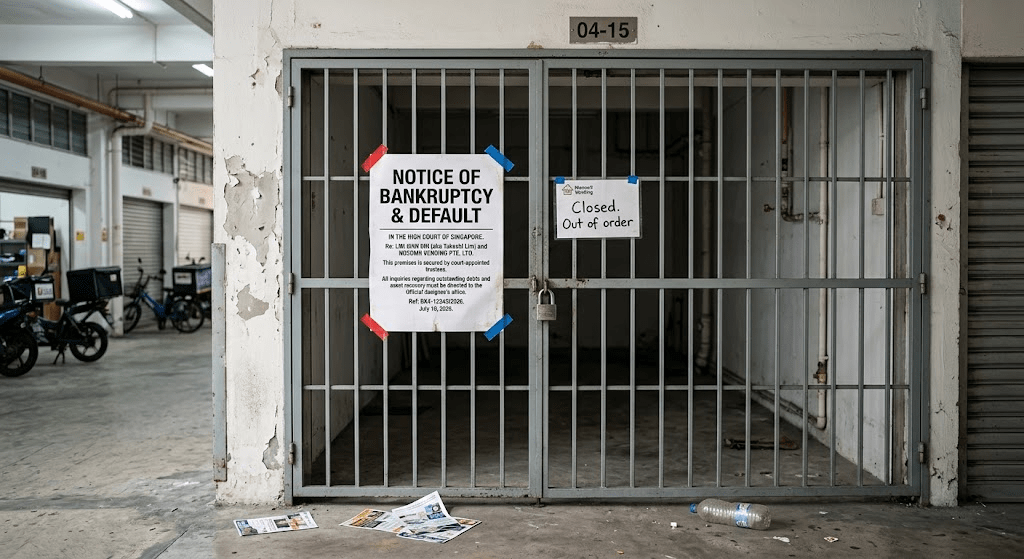
That image crumbled on July 14, 2026, when Lim was officially declared bankrupt. His company’s Admiralty office now stands empty, its locked gates plastered with debt notices stating that Lim and an associate owe at least $50,000 to immediate creditors.
The Schemes: High Returns, Guarantees, and Broken Machines
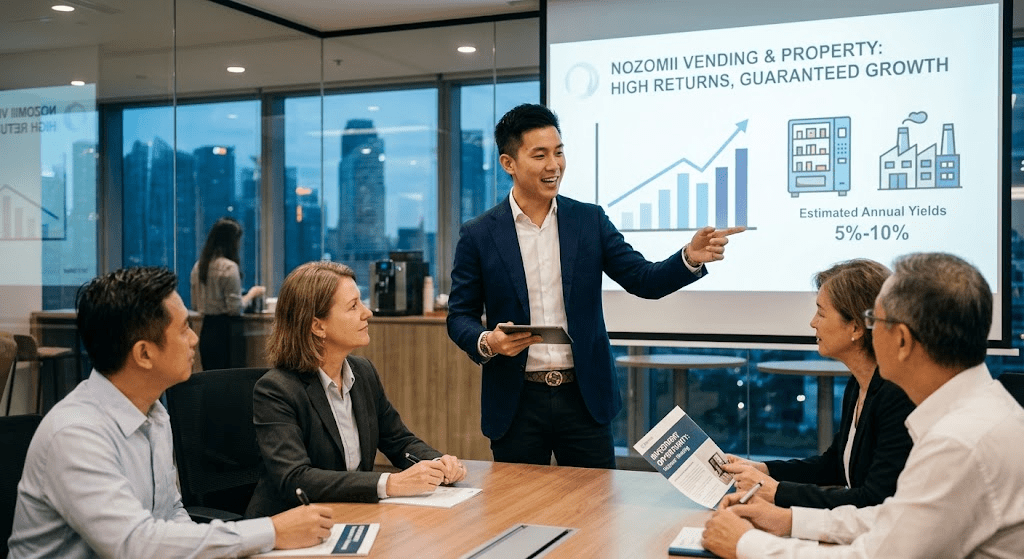
Between 2023 and 2026, Lim managed to convince over 40 investors to pour up to $4 million into his business ventures. The core offerings relied on two primary investment vehicles:
| Investment Scheme | Mechanism | Promised Returns |
| Vending Machine Fractional Ownership | Investors purchased individual machines or shares in a fleet placed in high-foot-traffic areas. Nozomii Vending was supposed to handle all operations and restocking. | 10% annual returns over a 4-year contract, paid out in regular fixed monthly dividends. |
| Industrial Property Schemes | Capital was pooled to buy into industrial units (such as properties in Ang Mo Kio). | 5% annual interest over a 3-year period. |
To make the deals sweeter, Lim assured victims that vending machines were low-risk cash cows. However, operational reality was far different. One local workshop contractor reported that a promotional machine Lim installed outside his shop only worked for three days out of five months before he requested its removal.
By February 2026, dividend payments slowed down to half-payouts. When pressed for repayments, Lim offered excuses ranging from needing time to liquidate properties to claiming he was facing “harassment and business sabotage” before cutting contact entirely.
Who Were the Investors?
The victims extended across different professions, including financial professionals who fell for the optics:
- Financial Industry Professionals: Kevin Lin, a 43-year-old financial adviser, invested $484,300 into Lim’s schemes—taking out $291,322 in bank loans to fund the investment. Lin recovered roughly $100,000 via a private debt recovery agency (JMS Rogers) shortly before the bankruptcy order, but remains significantly out of pocket.
- Personal Lenders: Other investors, like an investor named Yap, put $100,000 into the vending business and handed over an additional $150,000 as a direct personal loan based on Lim’s promises of short-term repayment.
- Retail & Working-Class Individuals: Everyday Singaporeans drawn by Lim’s workshops and PHV-driver-turned-tycoon story, trusting his personal brand over verified audited accounts.
When payments stopped, Lim sent vague WhatsApp messages expressing guilt before disappearing. Multiple police reports have been filed, and formal investigations are ongoing.
Echoes of Singapore’s Past Investment Scandals
The Nozomii Vending collapse bears striking similarities to other notable investment schemes in Singapore over the past decade:
- Envy Global Trading (2021): Founder Ng Yu Zhi raised over $1 billion from investors for a non-existent nickel trading scheme, offering quarterly returns of 15%. Like Lim, Ng funded a lavish lifestyle featuring supercars and hypercars to project legitimacy.
- The “Gold Buyback” Schemes (Ingot Capital, Genneva Gold): Promised guaranteed monthly cash payouts on gold purchases, relying on money from new buyers to pay older clients until the model collapsed.
- Shared-Economy Asset Fractionalization: Multiple crowdfunding collapses in Singapore have involved fractional ownership of physical assets—ranging from luxury cars to coffee shop stalls—where operational cash flow was heavily overstated to lure capital.
Key Takeaways for Everyday Investors
- Beware the “Flex” Culture: A luxury car or high-end watch is an expenditure, not a balance sheet. Flashy social media posts prove spending, not profitability.
- Guaranteed High Yields Don’t Exist in Low-Risk Assets: A fixed 5% to 10% annual payout on an unlisted physical asset carries significant operational risk. If a return sounds too stable for the yield offered, question the underlying mechanism.
- Never Fund Investments with Debt: Taking out personal or bank loans to fund speculative private schemes multiplies potential losses exponentially if the promoter defaults.
- Legal Limitations of Bankruptcy: Once a bankruptcy moratorium takes effect, individual recovery lawsuits stop, leaving creditors dependent on whatever assets the Official Assignee can liquidate. Waiting and hoping is rarely an effective recovery strategy.

 Kopi Kaki SG
Leave a comment