
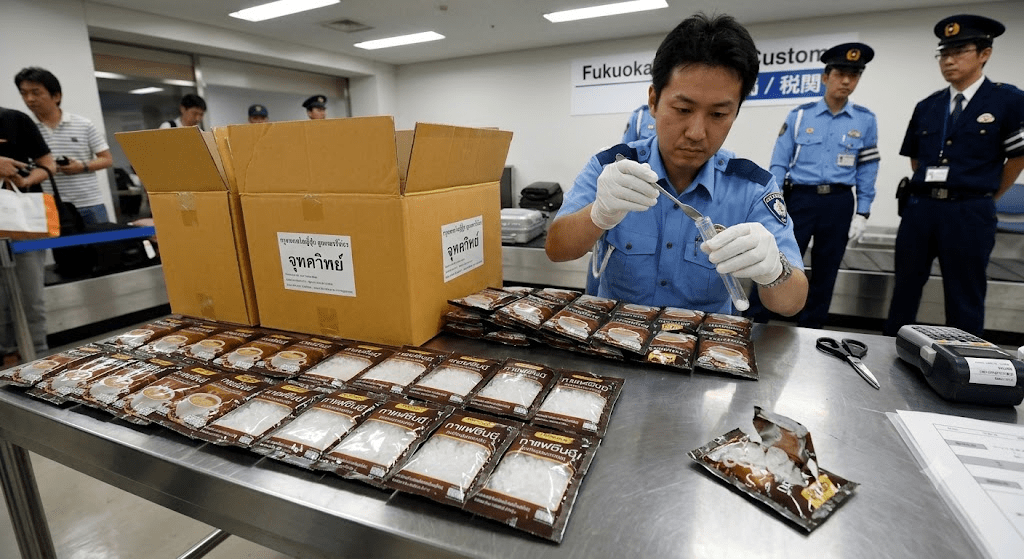
Wah kakis, pull up a chair, got hot news! You really need to listen to this one for your own safety—don’t say I never warn you. Japan is a very popular tourist destination for Singaporean, so knowing their drug laws is good info for you.
The Story: How a 12kg “Lobang” Turned Into a Trap
The girl inside the news is 28-year-old Juthathip Thongnoi. She and her boyfriend, Sarawut (who goes by “Ice”), run an informal “carry-for-hire” courier business for Thais living in Japan. The deal was simple: Thais pay them 300 baht (about S$11.50) per kilogram to carry snacks, local delicacies, and personal packages in their checked luggage when flying over to Japan. They had been running this business for over a year without any issues.
On July 10, a regular online customer using the LINE handle “ing ing” contacted them. This customer had used their service back in May to send basic snacks and coffee without incident, so everything seemed totally legit. The customer handed over a brown package weighing 12kg. The 3,600 baht (about S$138) delivery fee was transferred via a bank account under a Vietnamese name, “HO THI MAI”. Sarawut later noticed something slightly off—the customer’s Thai phrasing in the chat read like Google Translate, awkwardly mixing polite particles like “sir” and “madam”—but because they had transacted before, they didn’t think twice.
On July 11, Juthathip, Sarawut, and another friend boarded a flight from Bangkok’s Don Mueang Airport to Fukuoka. Inside their luggage were 9 separate customer parcels.
The moment they landed at Fukuoka Airport on July 12, reality hit them like a freight train. Japanese customs officers pulled the group aside for random luggage checks. When officers sliced open the 12kg brown package packed inside Juthathip’s bag, they found rows of standard-looking coffee sachets. Inside those sachets was not instant coffee powder, but crystal methamphetamine (“ya ice”).
While Juthathip was being detained, Sarawut frantically tried to contact the 9 recipients on LINE. Eight of the legit customers showed up to collect their everyday goods—but “ing ing” immediately vanished, deleted the account, and blocked them.
After 11 gruelling hours of interrogation, Japanese authorities cleared Sarawut and his friend because no drugs were found in their personal bags. But Juthathip was formally arrested for narcotics importation and customs violations.
Now back in Thailand, Juthathip’s distraught family and boyfriend have rushed to Bang Bua Thong Police Station and the Office of the Narcotics Control Board (ONCB). Armed with LINE chat logs, bank transfer receipts, and CCTV footage from when the parcel was handed over, they are begging Thai authorities to track down the syndicate mastermind before Japanese prosecutors decide whether to formally indict her.
Moral of the story: Never, ever help strangers or unverified online clients carry luggage or packages across borders. To the law, if it’s in your bag, it’s your responsibility!
The Legal Reality: Drug Laws in Japan and Thailand
This case sits at the intersection of two countries with some of the strictest drug control regimes in Asia.
1. Japan’s Laws & Enforcement (Where the Arrest Happened)
Japan operates on a zero-tolerance policy regarding narcotics, governed specifically by the Stimulants Control Act (覚醒剤取締法).
- Classification & Penalties: Methamphetamine falls under strict prohibition. Importing crystal meth carries a minimum sentence of 1 year in prison. However, if customs determines the smuggling was conducted for profit or commercial distribution—which is standard when large quantities like 12kg are involved—the punishment jumps to 3 years to Life Imprisonment, alongside heavy fines up to 10 million yen (~S$88,000).
- The “Hostage Justice” System: Japan allows police to hold suspects for up to 23 days without formal charge for continuous interrogation. Legal counsel is permitted, but defense attorneys are not allowed in the interrogation room. Once Japanese prosecutors formally indict a suspect, the conviction rate exceeds 99%.
- The “Unaware Mule” Defense: Proving “I didn’t know what was inside” is notoriously difficult in Japanese courts under the legal doctrine of wilful blindness (conditional intent). If a court decides that a person accepted money to transport items without verifying their contents—especially from an unverified online client—they can be held fully liable for drug trafficking due to gross negligence.
2. Thailand’s Laws & Extradition Framework (Where the Parcel Originated)
In Thailand, drug trafficking is regulated under the Narcotics Code B.E. 2564 (2021) and enforced by the Office of the Narcotics Control Board (ONCB) and the Royal Thai Police.
- Category 1 Narcotic: Crystal meth (ya ice) is classified alongside heroin as a Category 1 narcotic. Exporting or trafficking Category 1 drugs for commercial purposes carries penalties ranging from 10 to 20 years in prison up to Life Imprisonment, as well as fines up to 5 million baht.
- Strict Liability for Luggage: The ONCB repeatedly issues public warnings against “carry-for-hire” services. Thai legal precedent maintains that individuals accepting money to carry packages across borders assume full legal responsibility for the contents.
- Jurisdiction & Extradition: Because the physical drug seizure occurred in Fukuoka, Japanese jurisdiction takes precedence. Thai authorities are currently conducting a parallel investigation under Mutual Legal Assistance (MLAT) frameworks to track down the local syndicate handlers in Thailand. If convicted in Japan, any potential transfer back to a Thai prison would only be possible after serving a mandatory minimum portion of the sentence in Japan under bilateral agreements.
3. What If This Happened at Singapore’s Changi Airport?
If this exact scenario had unfolded at Changi Airport, the outcome would be exponentially more severe under Singapore’s Misuse of Drugs Act (MDA).
- The Death Penalty Threshold: Importing or trafficking more than 250 grams of methamphetamine carries a mandatory death penalty. A 12kg stash exceeds this threshold by tens of times.
- Legal Presumptions Shift the Burden: Under Sections 17 and 18 of the MDA, if drugs are found in your luggage, the court automatically presumes you know the drugs are there and that you intend to traffic them. The burden of proof falls entirely on you to prove otherwise.
- Escaping the Gallows is Barely Possible: To avoid capital punishment and receive Life Imprisonment (plus a minimum of 15 strokes of the cane), a courier must prove they were merely a transport mule AND receive a formal Certificate of Substantive Assistance from the Public Prosecutor for helping the Central Narcotics Bureau (CNB) dismantle the drug network. Without that certificate, the court has no discretion—the sentence is death by hanging.
Comparative Legal Matrix
| Jurisdiction | Law Enforced | Threshold Offense | Maximum Penalty for 12kg Meth |
| Japan | Stimulants Control Act | Import for commercial profit | Life Imprisonment + 10M Yen Fine |
| Singapore | Misuse of Drugs Act (MDA) | Importing >250g Meth | Mandatory Death Penalty (Hanging) |
| Thailand | Narcotics Code B.E. 2564 | Commercial export of Cat 1 Narcotic | Life Imprisonment (Up to Death Penalty) |
A Crucial Warning for Every Traveler
This tragic incident serves as a stark, sobering reminder that good intentions and a desire to make a quick buck can turn into a life-altering nightmare overnight. In the eyes of international law enforcement, ignorance of what is inside your bag is rarely accepted as a legal defense.
Whether it’s a long-time acquaintance, a repeat customer, or an online stranger offering a lucrative delivery fee, the rule remains absolute: if you didn’t pack it yourself and inspect every item inside, do not bring it across an international border. A few thousand baht in courier fees is never worth risking decades—or a lifetime—behind bars in a foreign prison.

 Kopi Kaki SG
Leave a comment