
Aiyo kakis, grab your kopi-o and sit down! Today we have some big drama to share. If you think scam cases only happen to blur aunties or uncles, think again. Even tech-savvy local content creators can fall into these trap doors when concert hype hits!
Here is the full breakdown of how local creator Clara Soh went from buying EXO concert tickets to accidentally becoming the literal face of a scam operation.
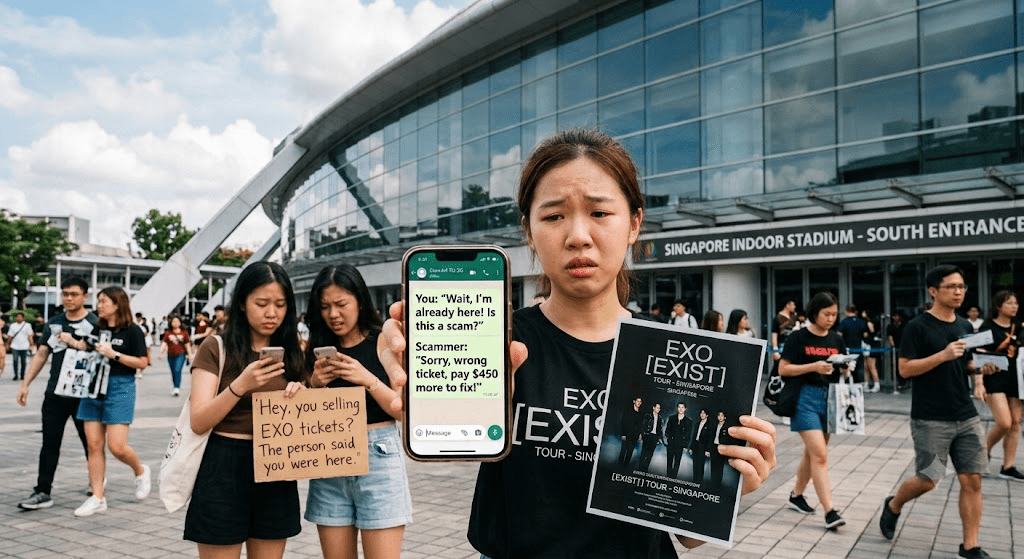
How the $800 Trap Unfolded
It all started when Clara was super eager to catch the EXO concert at the Singapore Indoor Stadium. As expected, official tickets were completely sold out, so she turned to X (formerly Twitter) to hunt for resale tickets. That single search was her first step into a masterclass in psychological manipulation.
It all started when Clara found a seller on X offering tickets and decided to reach out. To lock in her seats, the seller requested an initial $150 deposit. Clara completed the transfer using a PayNow QR code, even though a small voice in her head said the code looked suspicious—she was simply too excited to let the opportunity slip by.
Trying to play it safe, Clara then suggested a face-to-face (F2F) meetup to complete the purchase. The scammer quickly brushed off the idea with classic smooth-talking excuses: “No need lah, Ticketmaster transfer damn easy one!” Reassured by the confidence, Clara lowered her guard and transferred another $200 as requested.
Just when she thought the deal was done, the scammer hit her with the classic technical drama: “Aiyoh, transfer wrong ticket already!” The scammer claimed an additional $450 “fixing fee” was required to resolve the system error and release her seats. Desperate to secure her tickets after coming this far, Clara paid the fee. Just like that, $800 went straight down the drain.
Then came the ultimate plot twist. They had arranged to meet outside the Singapore Indoor Stadium on concert day, so Clara snapped a quick selfie outside the venue and messaged the scammer: “I’m here!” Moments later, two complete strangers walked up to her and asked, “Eh, you the one selling tickets ah?” It turned out the scammer had taken her selfie in real-time and forwarded it to other buyers on X to prove “she” was waiting outside—turning Clara into the unwitting poster girl for the entire scam operation.
Clara has since made a police report and updated her banking security details, but her main warning to everyone remains clear: Never buy event tickets on social media platforms like X!
5 Recent Cases of Singaporeans Getting Scammed
Clara’s case is far from an isolated incident. Here are 5 recent real-world scam stories in Singapore, detailing how victims were targeted and the exact amounts lost:
1. The BTS Concert Ticket Resale Trap
- How it happened: Following the announcement of BTS’s tour in Singapore, scammers swarmed X, Instagram, and Carousell listing fake tickets. Buyers transferred money via PayNow QR codes, only to be hit with repeated demands for bogus “admin fees” or “ticket release processing fees”.
- Amount lost: At least S$68,200 across 62 reported cases in just 10 days.
2. The Forced Moneylender “Safe Account” Scam
- How it happened: Victims received calls from scammers pretending to be telco representatives claiming unauthorized phone line registrations. The call was then transferred to fake “government officials” from the Ministry of Law or MAS. The fake officials accused victims of financial crimes and forced them to take out loans from licensed moneylenders to “facilitate investigations,” depositing the cash directly into scam accounts via ATMs.
- Amount lost: At least S$252,000 lost across 5 cases in three weeks.
Enjoying the story? Don’t wait for your kakis to forward you the gossip—subscribe here to get the freshest SG news dropped straight into your mailbox!
3. The Physical Gold Bar Handover Scam
- How it happened: To bypass bank transfer limits and mule account detection, scammers posing as police or government officials persuaded victims—primarily seniors—that their bank accounts were linked to money laundering. To prove their “innocence,” victims were instructed to buy physical gold bars from local jewelers and hand them over to “undercover couriers” for official inspection.
- Amount lost: Over S$242.9 million lost overall in government impersonation scams in 2025, with at least 131 individual gold bar handover cases.
4. Fake Government Official ATM Cash Deposit Scam
- How it happened: Victims were contacted by scammers claiming to be law enforcement or telecom regulators investigating fraudulent lines or illegal transactions. Victims were instructed to withdraw their life savings in cash and deposit the money into “safe accounts” using cash deposit ATMs, or physically hand over bank cards and PIN numbers to fake “inspectors”.
- Amount lost: At least S$5.4 million across 68 reported cases in a single month.
5. The Corporate Vendor Email Compromise (BEC) Scam
- How it happened: A Singapore-based commodities firm received an email purportedly sent by one of their regular supply chain vendors. The email claimed that the vendor’s bank account details had changed for all upcoming invoice settlements. Without double-checking via a phone call, the finance team processed the payment to the scammer’s bank account.
- Amount lost: S$57.2 million in a single transaction.
Key Takeaways: How to Stay Safe
- Never buy tickets off unverified social media platforms (X, Telegram, IG): Official ticketing platforms strictly control ticket transfers.
- Beware of top-up / “fixing” requests: The moment a seller asks for extra money to “fix an issue” or pay an “admin fee,” it is 100% a scam.
- No government agency demands transfers or cash deposits: Singapore government officials, police, MAS, or MinLaw will never ask you to transfer funds, purchase gold, or take out loans to “prove innocence.”

 Kopi Kaki SG
Leave a comment